
Fri Self-Care: The G.R.A.C.E. Protocol
You. Need. This. Because You’re Not a Machine (Even If the Healthcare System Treats You Like One)

There’s a strange phenomenon that happens when you live with chronic illness.
You can become the most compassionate person on the planet…
toward literally everyone except yourself.
A friend texts: “I’m exhausted today.”
Your response: “Of course you are. You’ve been through so much. Rest. ❤️”
You flare, cancel three plans, forget the laundry in the washer, and accidentally eat cereal for dinner again.
Your response to yourself:
“Wow. Really crushing it today, champ. NOT!”
Sound familiar?
Welcome to the Zebra Standard of Self-Treatment, where the bar for compassion toward others is in the stratosphere, but the bar for compassion toward ourselves is buried somewhere under a pile of heating pads and unanswered medical bills.
And I get it. Yes, I live it too.
When your life revolves around symptoms, appointments, research, medications, and trying to keep your nervous system from staging a full-blown coup… it’s easy to start believing you are the problem.
But here’s the truth that took me way too long to learn:
You don’t need more discipline.
You need more grace.
Which is why I propose something new for the Zebras Underground community.
Not a productivity system.
Not another “self-care routine” that involves green juice and sunrise yoga.
Something simpler.
Something humane.
Something I call:
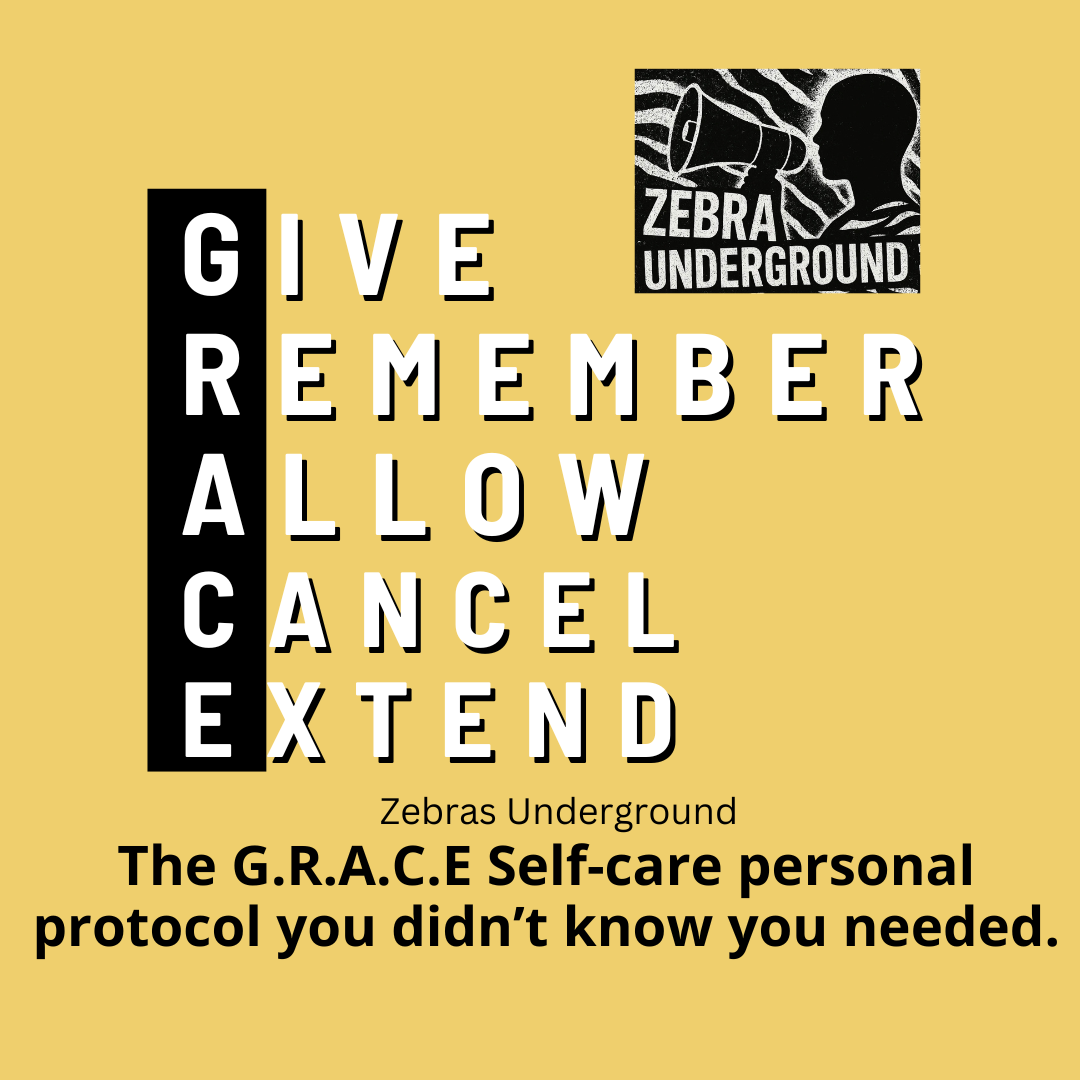
The G.R.A.C.E. Protocol
Because sometimes the most radical act in chronic illness is not being mean to yourself.
G — Give Yourself the Same Kindness You Give Others
Think about the last time a friend had a flare.
Did you say:
“Wow, you’re clearly not trying hard enough.”
No.
You probably said something like:
“Of course you’re struggling. Your body is dealing with a lot. What do you need?”
Now imagine saying that to yourself.
I know.
It feels illegal.
But here’s the experiment:
Next time you’re beating yourself up, pause and ask:
“If my best friend were having this exact day, what would I say to them?”
Then say that.
Out loud if necessary.
Yes, you may feel ridiculous.
But so is the internal monologue that sounds like a drill sergeant trained by WebMD.
R — Remember: Your Body Is Working Overtime
Most people’s bodies are quietly humming in the background.
Yours?
Your body is basically running six emergency trauma ER responses at all times.
Pain regulation
Autonomic chaos
Inflammation
Joint instability
Sleep disruption
Energy rationing like it’s wartime
And yet you still got up.
You still answered messages.
You still attempted life.
That counts.
Even if the world doesn’t measure it that way.
A — Allow Imperfect Days
Zebras are legendary for holding themselves to impossible standards.
We become:
• amateur medical researchers
• professional appointment coordinators
• symptom analysts
• insurance negotiators
• medication managers
…while also trying to be parents, partners, friends, workers, advocates, and humans who occasionally remember to hydrate.
And yet when the system breaks down, we think we failed.
Reality check:
You are operating a malfunctioning biological machine with no user manual and no support desk.
Of course there will be days when things fall apart.
That’s not failure.
That’s Tuesday.
C — Cancel the Comparison Olympics
Chronic illness comes with a bonus game nobody asked for:
Comparing yourself to healthier people.
They run marathons.
You run errands back-to-back between flare-ups.
They climb mountains.
You climb the stairs and consider it a major athletic event.
But here’s the truth:
Your race is not their race. Your starting line is not their starting line. And the fact that you are still moving forward — even slowly, unevenly, with detours through the land of heating pads — is actually pretty remarkable.
E — Extend Compassion Like It’s Medicine
If compassion were a drug, chronic illness patients would be massively under-prescribed.
We ration it.
We withhold it.
We act like we have to earn it.
But compassion isn’t a reward. It’s a survival tool. Studies show that self-compassion can reduce stress, improve coping, and decrease emotional distress in people with chronic illness.
Which makes sense.
Because when your body is already fighting a war, the last thing it needs is friendly fire from your own brain.
BTW - see my rant on why we need to stop using language like “warrior” to describe our situation.
A Simple Zebra Experiment
For the next week, try this:
Every time you catch yourself thinking:
“I should be doing more.”
Pause and replace it with:
“Given everything my body is dealing with, I’m doing the best I can today.”
Not the best possible version of you.
Not the ideal healthy version of you.
Today’s version.
That one counts too.
The Best Friend Test
When in doubt, ask yourself this:
“Would I say this to someone I love?”
If the answer is no…
Congratulations.
You’ve just discovered an opportunity to apply the G.R.A.C.E. Protocol.
Living with chronic illness requires a ridiculous amount of resilience. But resilience doesn’t come from being harder on yourself. It comes from learning how to stand on your own side.
Even on the messy days. Especially on the messy days. So today, consider this your official permission slip from the Zebras Underground community:
Lower the bar.
Cancel the self-criticism.
Drink the tea.
Rest the body.
And give yourself the gift that we so easily give everyone else.
Grace. 🦓
Greatest Real Advice Compassion Ever! Ty🩷
Thank you..stay soft stay loving..needed to hear this..i find the double edge of that lack of self-compassion is self-pity and life there sucks..✨grace✨🎶🎶🎶music makes it flow 🎶🎶🎶